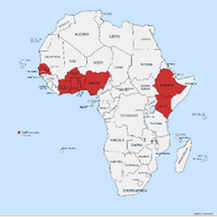
The JULES Academy was launched by UKCEH in 2025 in order to widen access to the JULES model and associated theory and techniques, especially in Africa. The JA was initially funded by the UKCEH National Capability for Global Challenges programme NCGC, which is designed to enhance the UK’s contributions to regional and global initiatives that deepen our understanding of how land–water–air system management influences the transition to Net Zero, supports climate adaptation, and addresses broader environmental challenges.
The JA will:
a) Link up academic and operational climate, water and land research through use of a shared modelling platform, leading to a much more efficient transition from model simulation to real-world impact,
b) Fast-track academics into international science by using a world-leading land surface model [JULES],
c) Improve the model in its representation of African environments from large catchment to continental scale, and
d) Work to foster development of a self-sustaining network of international JULES users and developers
Background:
The JULES model is used by leading international academics to explore the impact of climate change and extremes on the land. It is one of only about 10 such models in the world.
The JULES model is already used by many African agencies e.g. weather forecasting and drought forecasting.
In comparison to existing observational data, JULES works acceptably well in Africa, but observations are relatively sparse (e.g. flux towers) and the model remains based on global parameterisations that are at best approximate. Experience in other dry-land ecosystems (e.g., Australia) suggest that the model could be improved, leading to a better representation of Africa’s unique ecosystems and environments.
Bridging across scales is essential (this is a key component of the NCGC approach): we need to support two-way interactions between global initiatives and national-to regional-scale activities.
Expected benefits:
- Academic institutions and operational centres in Africa related to climate, water and land research developed improved capacity on land-surface modelling through improved access to and expertise on a leading land-surface model (JULES).
- Access to training on JULES in Africa is improved through the JULES Academy Regional Hub (JARH) model.
- Land surface modellers in Africa are better connected across the continent, and with the international JULES community, as a result of the JULES Academy Network.
- The representation of the African land-atmosphere system in the JULES model benefits from increased use of the model by African researchers and is improved, resulting in further benefits where JULES is applied (weather forecasting, land-use planning, water resources modelling agriculture, etc).
Launched in early 2025 by Dr Eleanor Blyth and Dr Rachael Turton (funded by the UKCEH National Capability for Global Challenges programme NCGC).
See here for Dr Blyth setting out the aims and intentions of the JULES Academy at the JULES Meeting in Leicester, UK, in September 2025.
See here for JULES Academy activity in late 2025/early 2026, including our workshops in September 2025 in Accra and January 2026 in Nairobi.